Comprehensive Anti-Aging Case Study: Deep Plane Facelift, Endoscopic Forehead Lift, and Blepharoplasty in a 60-Year-Old Patient
Facial aging does not occur as an isolated event in a single area; rather, it progresses organically across the forehead, periorbital region, midface, and neck. By the age of 60, patients frequently present with a complex combination of tissue laxity, structural descent, and loss of skin elasticity. Addressing these multifaceted concerns requires an organic, multi-dimensional surgical approach rather than isolated procedures.
In this clinical case study, we examine a 60-year-old female patient who presented with eyelid hooding, severe forehead and glabellar lines, infraorbital hollowing, jowling, marionette lines, submental fat accumulation (double chin), and neck laxity. She underwent a harmonious combination of Deep Plane Facelift, Endoscopic Forehead Lift, and Upper & Lower Blepharoplasty.
[Legal & Ethical Notice] All patient photographs and clinical data utilized in this post were captured and published with the patient’s explicit, voluntary consent in accordance with medical law and regulatory compliance. Unauthorized duplication or distribution is strictly prohibited.
1. Patient Presentation and Comprehensive Clinical Diagnosis
- Chief Complaints: Upper eyelid hooding, forehead wrinkles, glabellar lines, lower eyelid bags/sagging, tear trough depressions, nasolabial folds, jowls, marionette lines, submental fullness, neck wrinkles, and neck sagging.
Anatomical & Structural Breakdown:
- Upper Face: The patient presented with pre-existing asymmetric double eyelids. Due to severe skin and tissue hooding, she unconsciously recruited her frontalis muscle to elevate her brows, creating deep horizontal forehead creases and chronic late-day ocular fatigue and heaviness. Performing upper blepharoplasty alone would have caused a harsh, tightened expression and worsened glabellar and nasal bridge wrinkles. Furthermore, her unique anatomical trait of slightly prominent eyes required minimizing the upper eyelid crease height.
- Mid-to-Lower Face & Neck: Infraorbital fat herniation and skin laxity were concurrent with mid-to-lower facial descent (nasolabial folds, jowls, marionette lines). Subplatysmal fat accumulation and weakened platysmal muscle tone resulted in submental fullness and noticeable neck sagging.

2. Customized Multi-Modal Surgical Plan
To resolve the root causes of multi-plane aging, a customized, harmonious surgical strategy was designed:
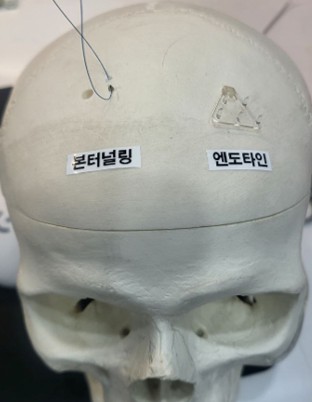
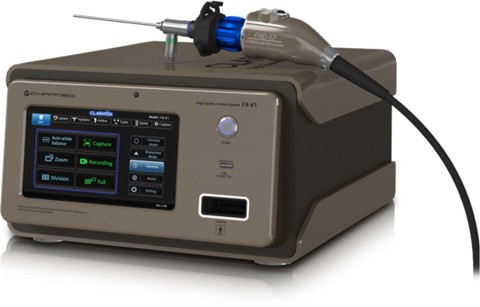
- Endoscopic Forehead Lift & Upper Blepharoplasty: Utilizing four minimal incisions within the scalp, the forehead was endoscopically dissected and secured using Endotine fixation to smooth glabellar and forehead lines while positioning the brows ideally. The upper eyelid crease was designed conservatively to eliminate the heaviness of prominent eyes while preserving a soft expression.
👉 Read More: Why Upper Blepharoplasty Can Look Unnatural: The Eye-Brow-Forehead Connection
👉 Read More: Comprehensive Guide to Endoscopic Forehead Lift: Incisions, Dissection, Fixation, and Before & Afters - Lower Blepharoplasty: Herniated infraorbital fat was repositioned, the orbicularis oculi muscle was secured, and redundant skin was precisely excised. Because this was performed alongside a deep plane facelift, the skin excision volume was meticulously calculated to maximize synergy.
- Deep Plane Facelift: Moving beyond superficial skin tensioning, true retention ligaments were released via a deep plane technique, accompanied by deep malar fat pad repositioning to restore smooth, natural midface-to-jawline contours. Incisions followed the hairline, pre-auricular, and retro-auricular creases to minimize visible scarring.
👉 Read More: Facelift Notes: What is SMAS? The Hidden Facial Structure for Youthful Rejuvenation - Neck Lift: Through a submental micro-incision, subplatysmal fat was excised, separated and sagging muscles were tightly sutured, and a lateral platysmal hammock technique was applied to elevate and define the neck contour.
3. Detailed Angular & Stage-by-Stage Recovery Analysis
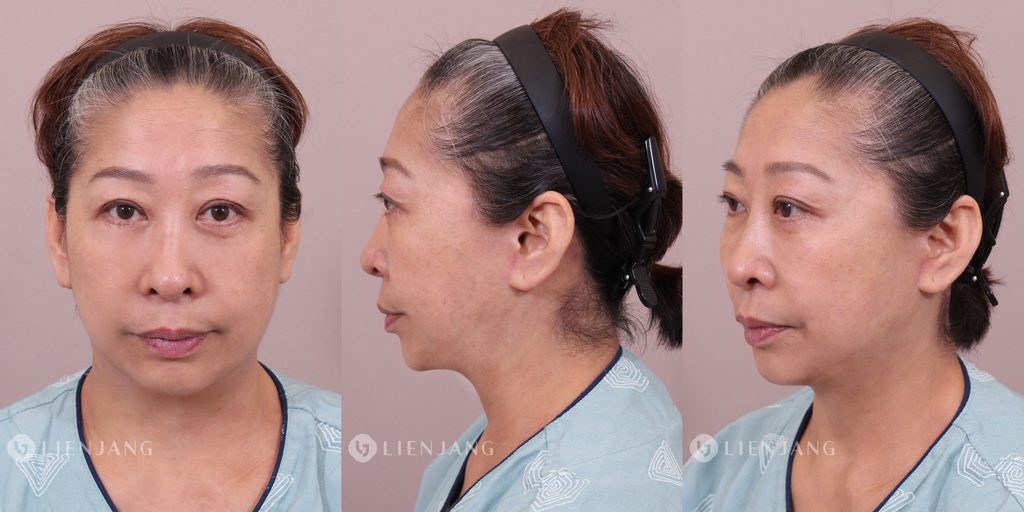
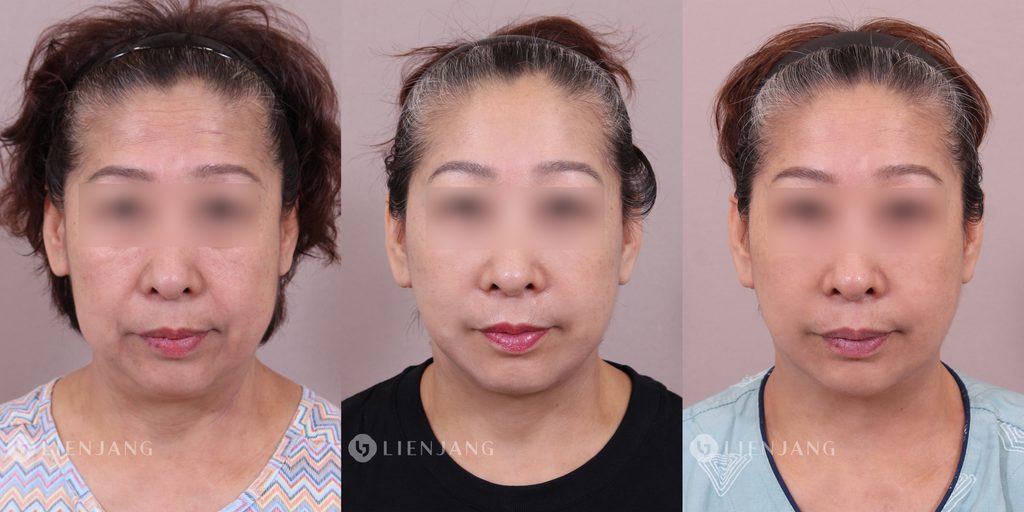
📍 [Frontal View Analysis]: Restoration of Expression, Symmetry, and Lower Facial Slimming
- Pre-op: Deep horizontal forehead and glabellar lines dominated the upper face, while heavy upper eyelids obscured the pupils, creating a fatigued look. Jowls and marionette lines added undesirable weight to the lower third of the face.
- 1 Month Post-op: The endoscopic forehead lift elevated the brows, smoothing forehead lines and relieving late-day heaviness. Post-blepharoplasty swelling subsided, correcting asymmetry, while initial deep plane facelift recovery began to refine the lower jawline.
- 3 Months Post-op: Residual swelling completely resolved, achieving balanced bilateral symmetry. The conservative double eyelid crease and smooth lower facial contours established a refreshed, elegant, and youthful frontal appearance.
📍 [45-Degree View Analysis]: Midfacial Volume Restoration and S-Line Contouring
- Pre-op: Tear trough depressions and lower eyelid fat bulging created harsh midfacial shadows, compounded by deep nasolabial and jowl boundaries.
- 1 Month Post-op: Lower blepharoplasty fat repositioning and deep plane lift synergy smoothed the infraorbital transition. Malar fat repositioning restored natural anterior cheek volume along the 45-degree vector.
- 3 Months Post-op: Unwanted textural irregularities and deep folds were completely smoothed out, resulting in a continuous, youthful, and vibrant S-line facial profile from any angle.

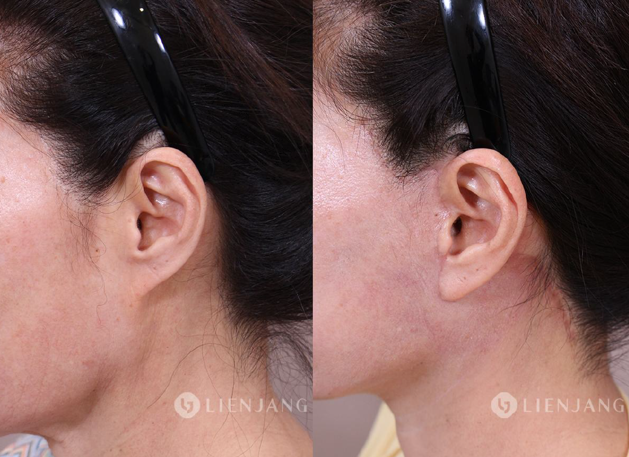
📍 [Profile View Analysis]: Jawline Definition and Cervico-Mental Angle Restoration
- Pre-op: Heavy jowls disrupted the jawline, while submental fat and a lax platysma created an obtuse, unbroken double-chin transition between the chin and neck.
- 1 Month Post-op: The deep plane vector retracted jowl heaviness, and primary submental tightening began defining the lateral jawline angle.
- 3 Months Post-op: The deep plane technique and platysmal hammock fixation fully settled, rendering a sharp, well-defined cervico-mental angle. Retro-auricular and hairline scars healed invisibly, producing a crisp, refined profile that restored a decade or more of structural youth.

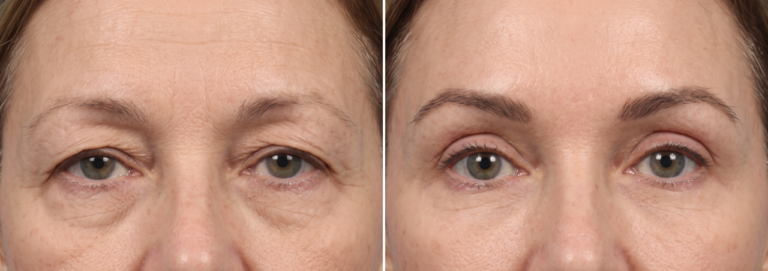
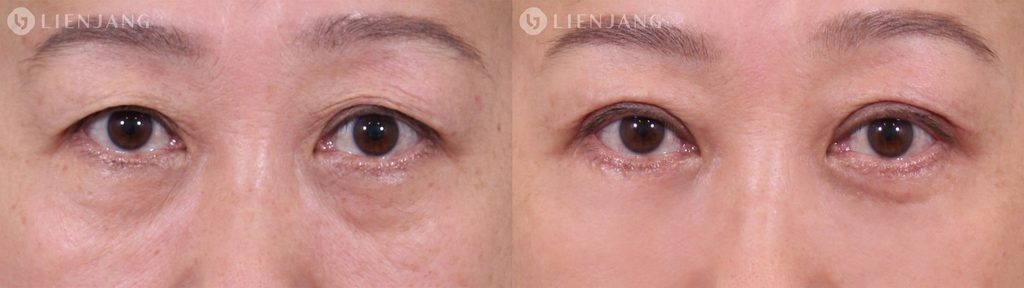
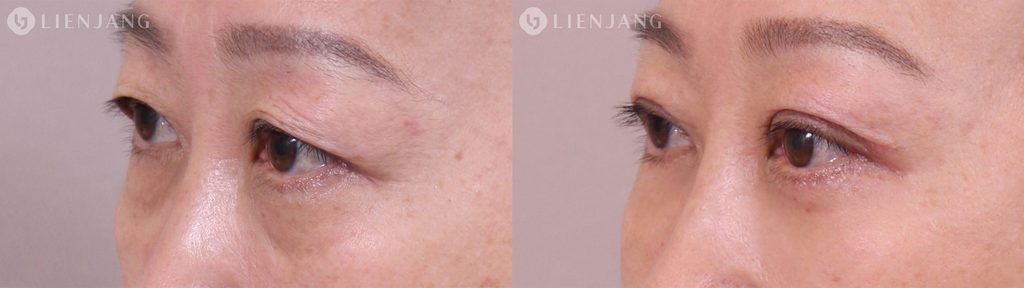
📍 [Periocular (Eye) Progression & Analysis]: Pre-op vs. 3 Months Post-op
[Image Placement: Periocular Photos]
- Photo Description: Periocular Progression View (Left: Frontal View [Pre-op vs. 3 Months Post-op] | Right: Profile View [Pre-op vs. 3 Months Post-op])
- Caption Text: “Comparison of the periocular region (pre-operative vs. 3 months post-op), illustrating the correction of eyelid asymmetry, natural restoration of a soft double eyelid crease, and relief of late-day ocular fatigue without a tight or unnatural appearance.”
- Pre-op: Deep horizontal forehead creases and glabellar lines were prominent, while sagging upper eyelids obscured the pupils, causing chronic ocular heaviness and fatigue by the afternoon.
- 3 Months Post-op: Residual swelling completely resolved, establishing flawless bilateral symmetry from the frontal view. The conservatively designed, soft double-eyelid crease harmonized with the smoothed forehead and lower facial contours, achieving an alert, elegant, and youthful gaze.
4. Angular Before & After Comparisons (Pre-op vs. 3 Months Post-op)
- ① Frontal Comparison: Transition from a tired, heavy upper face and sagging lower jawline to an alert, symmetrical, and gracefully balanced facial framework.
- ② 45-Degree Comparison: Elimination of midfacial shadows and harsh tear troughs, replaced by a seamless, convex, and youthful volume transition.
- ③ Profile Comparison: Transformation from an undefined jaw-neck blend to a sleek, sharply contoured cervico-mental angle with pristine scar concealment.


5. Overall Image Transformation & Clinical Summary
“Achieving natural, elegant rejuvenation without looking ‘overdone’ or surgically altered.”
The ultimate success of this case stems from treating facial aging not as isolated surface issues, but as a comprehensive structural continuum encompassing the upper face, mid-to-lower face, and neck simultaneously.
- Elimination of Fatigue: Chronic periorbital and forehead tension was lifted, replacing a heavy expression with relaxed, bright eyes.
- Harmonic Volume and Tension: Structural descent was reversed through precise anatomical repositioning rather than superficial pulling.
- Total Anti-Aging Synergy: Frontal, 45-degree, and profile proportions were unified to establish a naturally revitalized silhouette.
Frequently Asked Questions (FAQ)
Q: What is a Deep Plane Facelift, and how is it different from a traditional facelift? A: A Deep Plane Facelift is an advanced surgical technique that releases deep facial retention ligaments and repositions the deeper facial muscles and fat pads (such as the malar fat pad) as a single unit. Unlike traditional facelifts that only pull or tension the superficial skin, a deep plane approach treats the root cause of aging, resulting in a much more natural, long-lasting rejuvenation without a “pulled” or tight look.
Q: Why is an Endoscopic Forehead Lift combined with Upper Blepharoplasty in older patients? A: In patients experiencing heavy upper eyelid hooding, the brow often drops significantly. Performing upper blepharoplasty alone can over-excise skin, leading to a harsh, unnatural expression and worsening glabellar/forehead wrinkles due to continued muscle strain. An Endoscopic Forehead Lift elevates the brows to their ideal anatomical position, allowing the upper eyelids to be treated conservatively for a soft, harmonious, and youthful result.
Q: How does a combined Deep Plane Facelift and Neck Lift improve the jawline and neck? A: Facial aging often blurs the boundary between the jaw and the neck due to jowling, submental fat accumulation, and platysmal muscle laxity. A combined approach treats the mid-to-lower face via deep plane repositioning while addressing the neck through submental fat removal, direct muscle tightening, and a lateral platysmal hammock technique. This restores a sharp, well-defined cervico-mental angle.
Q: What is the typical recovery timeline after a comprehensive multi-modal facial rejuvenation? A: While major swelling and bruising begin to subside significantly within the first 2 to 4 weeks (allowing patients to return to light daily activities), internal tissues continue to settle. The final, refined results—complete with soft expressions, normalized tissue texture, and invisible scar maturation along the hairline and retro-auricular creases—are typically achieved around 3 months post-operation.
Q: Can a Deep Plane Facelift correct jowls and marionette lines effectively? A: Yes. Jowls and marionette lines are primarily caused by the downward descent of deep facial fat pads and the tethering of retention ligaments. A Deep Plane Facelift releases these deep ligaments and repositions the descended tissues back to their youthful vector. This eliminates jowling and softens marionette lines naturally without relying on superficial skin tension.
Q: Where are the incisions located for a Deep Plane Facelift and Neck Lift, and are scars noticeable? A: For a Deep Plane Facelift, incisions are strategically placed along the natural contours of the hairline, within the pre-auricular and retro-auricular creases. For the neck lift, a tiny submental micro-incision is made hidden beneath the chin. Because tension is placed on the deep muscular layer (SMAS/platysma) rather than the skin, the incisions heal under zero tension, resulting in fine, well-concealed scars that blend invisibly into the hair and natural skin creases over time.
Q: Why is combining a Lower Blepharoplasty with a Facelift beneficial? A: Combining lower blepharoplasty and a facelift allows the surgeon to treat the midface and lower face as a continuous, unified anatomical unit. Specifically, it enables precise coordination of skin excision volumes between the lower eyelid and the cheek/facelift vectors, preventing any unnatural pull or tension distortion around the lower eyelid margin while creating a seamless, youthful transition from the eyes down to the jawline.
Q: What makes the Endotine fixation effective in an Endoscopic Forehead Lift? A: Endotine is a bio-absorbable fixation device utilized during an endoscopic forehead lift to secure the elevated scalp and brow tissues securely to the bone in their new, ideal position. It distributes tension evenly across multiple points, providing stable mechanical fixation during the crucial early healing phase while the tissues naturally re-adhere, after which the device safely dissolves on its own.
⏱️ Post-Operative Recovery Timeline at a Glance
- Days 1–7 (Acute Recovery): Initial swelling, bruising, and tension peak; sutures and drains (if any) are typically removed within the first week. Rest and light indoor activities are recommended.
- Weeks 2–4 (Social Integration): Major bruising and residual swelling subside significantly, allowing patients to return to light daily routines, work, and public outings with minimal camouflage.
- Months 1–3 (Tissue Settling & Final Maturation): Deep tissues completely settle, subtle firmness softens, and scars continue to fade, revealing the ultimate, natural anti-aging outcome by the 3-month mark.
👤 Who is an Ideal Candidate for This Comprehensive Multi-Modal Rejuvenation?
- Patients with Multi-Planar Aging: Individuals exhibiting simultaneous structural descent across the upper face (brow/eyelids), midface (tear troughs/jowls), and lower face/neck.
- Those Seeking Natural Results: Patients who want to avoid the “pulled” or “wind-swept” look associated with superficial skin-only facelifts.
- Patients Experiencing Functional Fatigue: Individuals suffering from chronic late-day ocular heaviness caused by heavy upper eyelids forcing compensatory frontalis (forehead) muscle strain.
🔬 Key Clinical Takeaway: The Synergy of Multi-Modal Rejuvenation
| Procedure Component | Target Anatomical Area | Primary Clinical Objective |
| Endoscopic Forehead Lift | Upper Face & Brows | Elevates descended brows, smooths horizontal/glabellar lines, relieves ocular fatigue. |
| Upper & Lower Blepharoplasty | Periorbital Region | Corrects eyelid hooding, repositions herniated fat, and refines tear troughs. |
| Deep Plane Facelift | Midface & Lower Face | Releases retention ligaments, repositions deep fat pads, and eliminates jowls. |
| Neck Lift & Platysmal Repair | Submental & Neck | Removes subplatysmal fat, tightens separated muscles, and defines the jawline. |
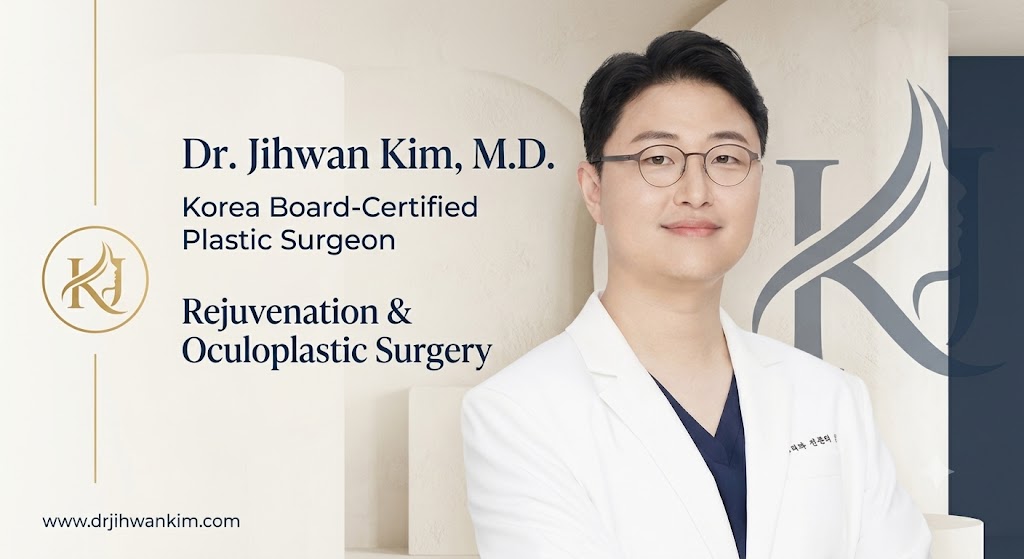
Experience natural, harmonious anti-aging tailored exclusively to your unique facial structure. Discover more about our advanced lifting and surgical programs at Lienjang Plastic Surgery.
👉 [Explore Lienjang Plastic Surgery]


Medical Disclaimer:The content provided on this blog is for informational and educational purposes only and does not constitute medical advice, diagnosis, or treatment. Individual surgical results may vary, and all medical or surgical procedures carry inherent risks. Always seek the advice of a qualified healthcare provider with any questions regarding a medical condition or treatment options.