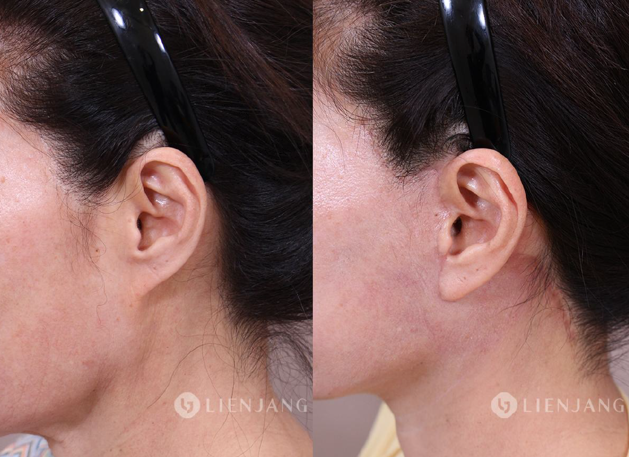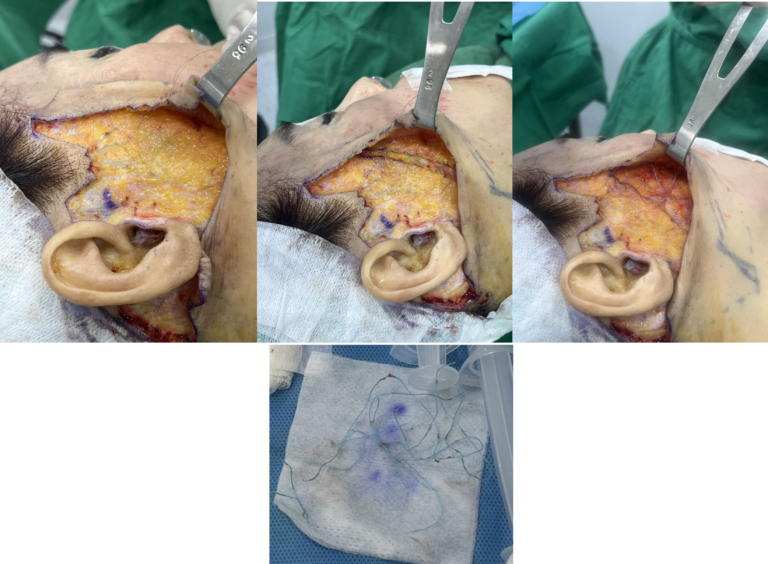
Facelift Notes: What is SMAS? The Hidden Facial Structure for Youthful Rejuvenation
What is the SMAS layer?
– The essential facial structure you must know before considering a facelift.
1. Why Doesn’t Simply Tightening the Skin Last?
“Is there a procedure that just gently pulls back the skin?”
This is one of the most common questions I hear from patients interested in facelift procedures.
In the past, skin-only facelifts were quite common. However, over time, patients often experienced rapid relapse (re-sagging) or ended up with an unnatural, “pulled” appearance.
Why does this happen? Because the face is made up of much more than just the outer layer of skin.
2. Deep Within the Face Lies the ‘SMAS’ Layer
Beneath the skin, positioned between the subcutaneous fat and muscle layers, is a distinct tissue layer called SMAS.
SMAS stands for Superficial Musculo-Aponeurotic System (often referred to as the superficial fascia).
Simply put, it is a deep fascial structure that controls both facial movement and sagging. Whenever you make facial expressions or experience skin laxity over time, the SMAS layer moves and stretches along with it.
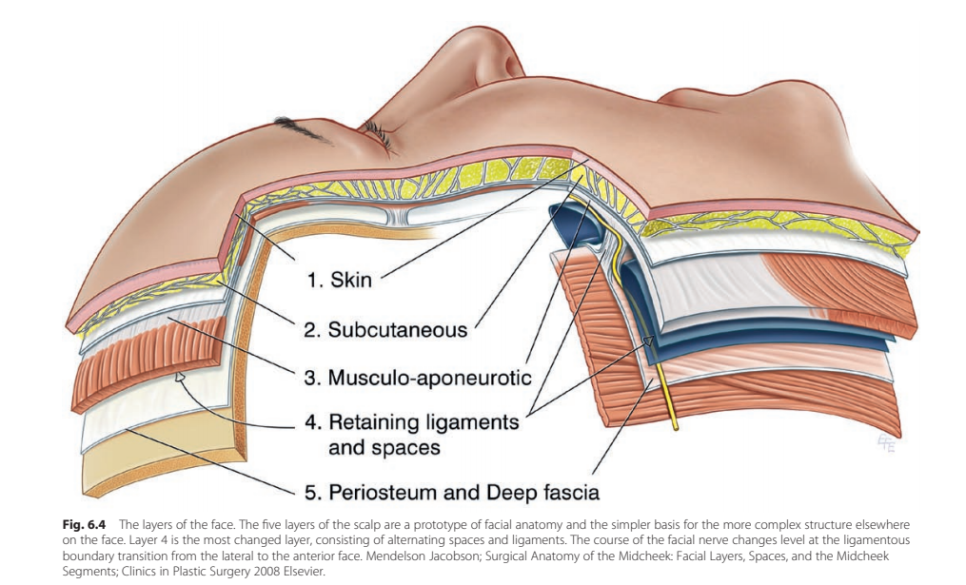
(Image Source: Mendelson BC. Facelift anatomy, SMAS, retaining ligaments and facial spaces. In: Aston SJ (ed). Aesthetic Plastic Surgery, Vol. 1. Saunders Elsevier, 2009.)
3. Is SMAS a Defined Anatomical Structure?
From a strict anatomical standpoint, the SMAS is not a completely isolated, distinct single structure. Rather, it is a functional unit surgically defined for clinical utility.
In other words, instead of being a rigidly demarcated tissue layer found in traditional anatomy textbooks, it represents the manageable tissue plane located beneath the skin that a surgeon operates on.
Therefore, it is more precise to view the SMAS as a “surgical plane” rather than a standalone anatomical entity.
4. True Lifting Requires Elevating the SMAS
Pulling only the skin simply addresses the superficial envelope; naturally, it stretches back out in a short period.
In contrast, when you elevate and reposition the SMAS layer alongside the skin, you restore the fundamental support system of the face. This delivers significantly more natural and long-lasting results.
Surgical techniques that address these deeper structural layers—including the SMAS—are known as SMAS Facelifts or Deep Plane Facelifts.
5. Where is the SMAS Located in the Face?
While the SMAS extends across the entire face, its structural characteristics vary depending on the area:
| Facial Region | SMAS Component / Structure |
| Forehead | Galea aponeurotica |
| Temporal Region | Superficial temporal fascia |
| Cheeks & Midface | Thin fascial layer covering the zygomaticus muscles |
| Jawline & Neck | Superficial fascial structure continuous with the Platysma muscle |
As shown above, the SMAS is not a single uniform structure with fixed boundaries, but rather a continuous layer composed of tissues with varying regional properties.
6. The Face: Mobile Layers vs. Anchoring Layers
To look a bit deeper, facial anatomy can be categorized into two primary structural layers:
- Gliding Planes
- The dynamic layer where the skin, subcutaneous fat, and SMAS move together.
- Over time, gravity and aging cause this entire layer to slide downwards.
- Retaining Ligaments
- Fibrous ligamentous structures that anchor soft tissues to the underlying bone or deep fascia.
- Key retaining ligaments include:
- Zygomatic ligament
- Temporal ligament
- Mandibular ligament
The core mechanism of an effective facelift is to properly release or preserve these retaining ligaments while repositioning the gliding plane—including the SMAS—back to its youthful position.
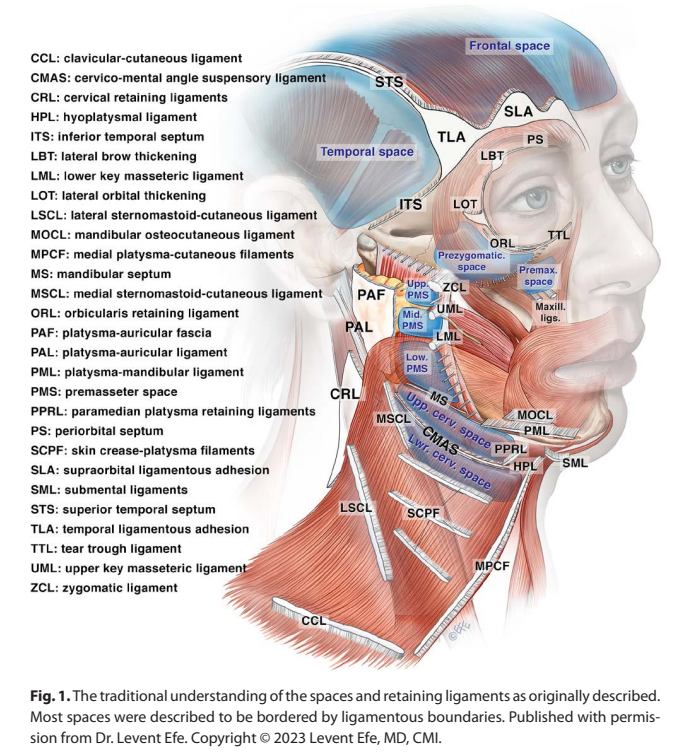
(Image Source: Mendelson BC. Anatomy of the Facial Glideplanes, Deep Plane Spaces, and Ligaments: Implications for Surgical and Nonsurgical Lifting Procedures. Plast Reconstr Surg. 2024;153(6):1195–1208.)
7. What Defines a Truly Great Facelift?
Skin-only tightening quickly succumb to gravitational relapse.
A structural facelift that properly addresses the SMAS restores three-dimensional volume, provides natural outcomes, and ensures lasting longevity.
This approach goes beyond pulling the surface—it is about restoring the underlying framework back to where it belongs.
Key Takeaways
- The SMAS is best understood as a surgically manageable functional plane rather than a strictly isolated anatomical layer.
- As a critical structure governing facial elasticity and movement, the SMAS must be addressed during rejuvenation surgery.
- An SMAS/Deep Plane Facelift restores deep structural layers, delivering longer-lasting and significantly more natural results.
While the concept of the SMAS may sound complex, it holds the absolute key to successful facial rejuvenation. Real lifting and meaningful transformation always depend on how masterfully this deep layer is handled.

Medical Disclaimer:The content provided on this blog is for informational and educational purposes only and does not constitute medical advice, diagnosis, or treatment. Individual surgical results may vary, and all medical or surgical procedures carry inherent risks. Always seek the advice of a qualified healthcare provider with any questions regarding a medical condition or treatment options.